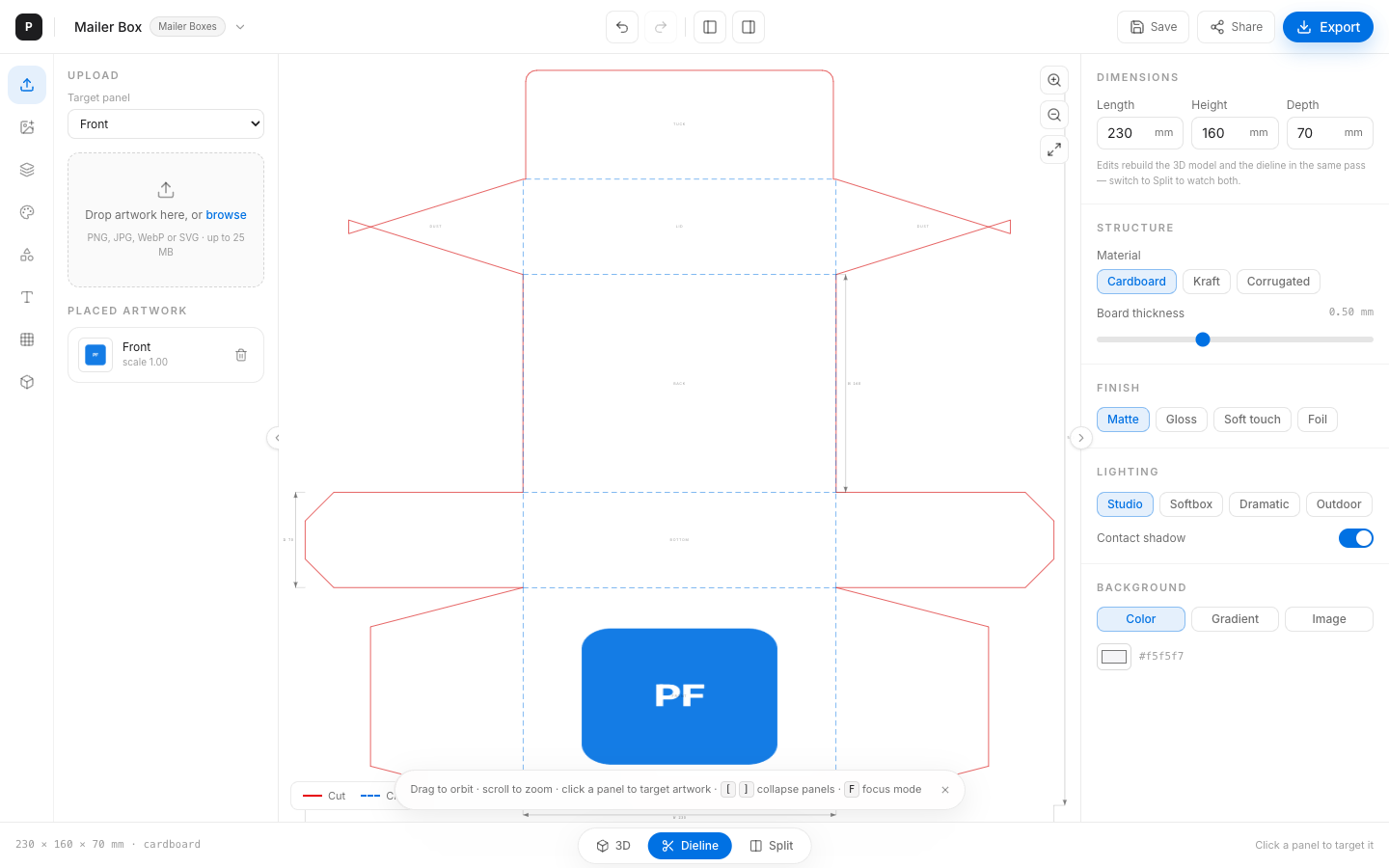
Brand designers, packaging engineers, agencies, and e‑commerce brands still bounce between disconnected 2D artboards, static 3D mockups, and printer-supplied dielines. PacFully exists because that fragmentation is expensive.
Who hurts
Brand designers
Need photoreal mockups for reviews and storefronts, but cannot wait days for a studio render every time dimensions change.
Packaging engineers
Own structural integrity: flap geometry, glue tabs, FEFCO-style blanks. Marketing mockups that ignore manufacturing logic create rework.
Agencies
Juggle multiple SKUs and clients; static template packs and surprise export paywalls erode margins and trust.
E‑commerce / DTC brands
Ship mailers and cartons constantly. Unboxing and PDP imagery must match the carton that actually folds on the floor.
Cost of traditional 3D + dielines
- Time — commissioning a 3D artist or waiting on a CAD house for each size revision.
- Money — studio mockups billed per shot; print proofs when the dieline was wrong.
- Fidelity gap — JPG “dielines” and low-res exports rejected by converters.
- Tool tax — desktop suites for structure, separate WebGL toys for marketing, Illustrator for art.
Fragmented 2D ↔ 3D workflows
Typical path today:
- Receive a PDF dieline from the printerOften a one-off blank with unclear cut vs crease layers.
- Place artwork in Illustrator / AffinityPanel boundaries guessed from guides; bleed added manually.
- Build or buy a 3D mockupTextures projected once; dimension changes orphan the render.
- Client changes the height by 8 mmEverything rebuilds out of sync — dieline, mockup, and share links diverge.
Why this matters for print-ready packaging
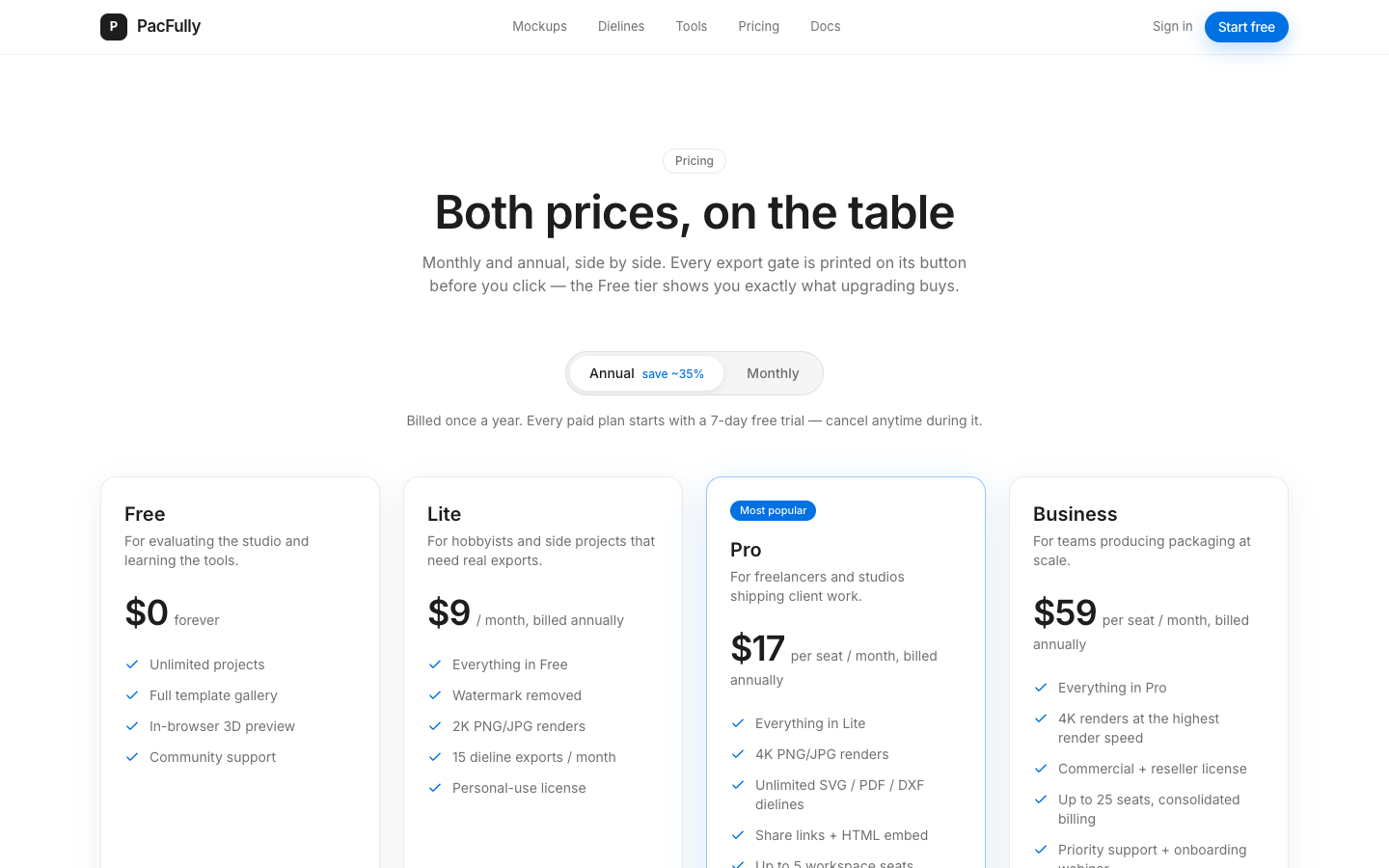
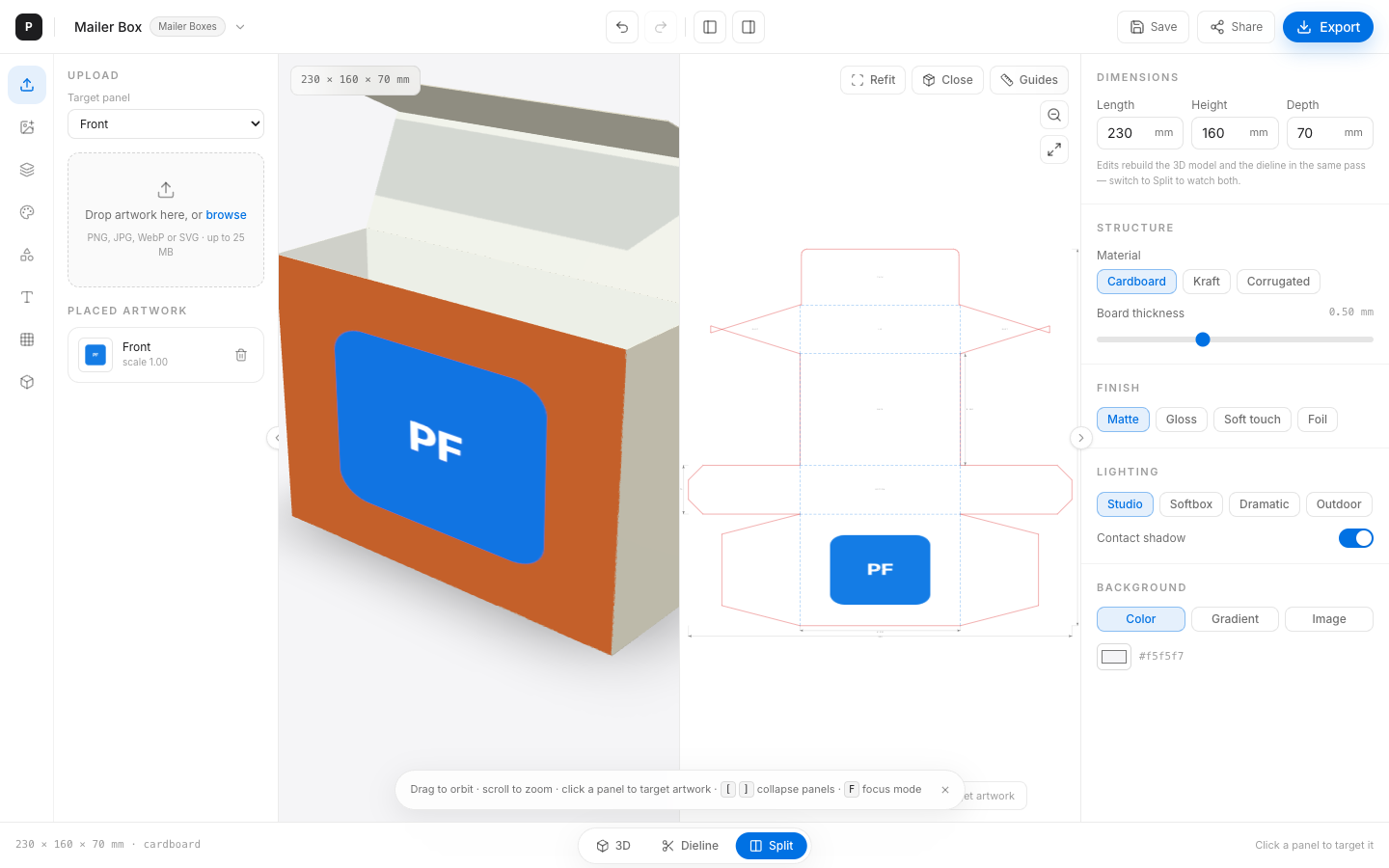
Print converters need vector cut and crease geometry in millimetres, not screenshots. Marketing needs believable 3D under lighting. When those two worlds share one parametric source, SKU iteration becomes minutes instead of revision cycles.
Honest limit: PacFully dielines are manufacturing-plausible (±0.5 mm documented intent), not die-cutter-certified. Always proof with your converter. PDF export is currently a browser print sheet — SVG and DXF are the true vector outputs.